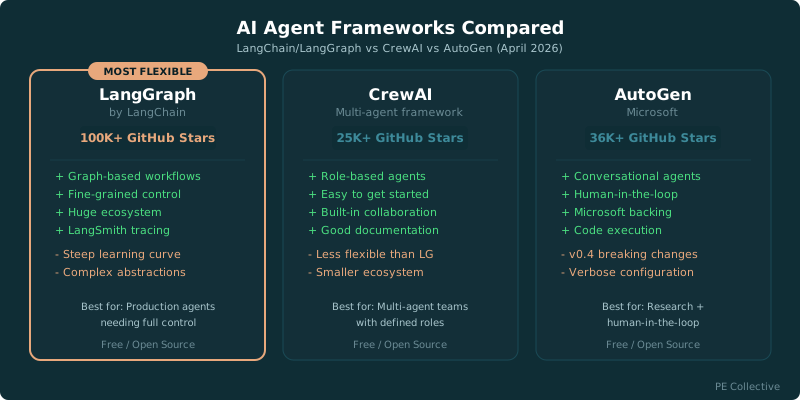
Building AI agents is the hot topic in AI engineering right now. Every company wants autonomous systems that can plan, execute, and iterate on complex tasks. The question is which framework to build on.
This comparison covers the three frameworks that matter most in 2026: LangChain (specifically LangGraph for agents), CrewAI, and Microsoft's AutoGen. I've built production systems with all three. Here's what I actually think about each one.
What AI Agent Frameworks Do
Before comparing tools, let's clarify what we're building. An agentic AI system is one where the model doesn't just respond to prompts. It reasons about goals, plans steps, uses tools, observes results, and adjusts its approach. Think of the difference between asking someone a question (standard LLM) and giving someone a project to complete (agent).
Agent frameworks handle the infrastructure for this: managing the reasoning loop, connecting to tools, maintaining state across steps, handling errors, and coordinating multiple agents when needed. You could build all of this yourself with raw API calls, but frameworks save weeks of engineering work on the plumbing so you can focus on the logic.
LangChain / LangGraph
LangChain is the most popular AI framework by a wide margin. LangGraph is its purpose-built library for creating agent workflows as graphs. If you're building agents with LangChain in 2026, you're using LangGraph.
Architecture
LangGraph models agent workflows as state machines. You define nodes (functions that process state), edges (transitions between nodes), and a state schema that flows through the graph. This is fundamentally different from the chain-based approach LangChain started with.
The graph model is powerful because it handles cycles naturally. An agent that needs to retry a step, gather more information, or loop through a planning process is just a graph with cycles. You define the logic for when to move forward and when to loop back.
Code example: A simple research agent
Here's what a basic research agent looks like in LangGraph. The agent searches for information, evaluates whether it has enough, and either searches again or writes a summary.
from langgraph.graph import StateGraph, END
from typing import TypedDict, List

class ResearchState(TypedDict):
    query: str
    sources: List[str]
    summary: str
    enough_info: bool

def search(state: ResearchState) -> ResearchState:
    # Search for information
    results = search_tool(state["query"])
    state["sources"].extend(results)
    return state

def evaluate(state: ResearchState) -> ResearchState:
    # Check if we have enough information
    state["enough_info"] = len(state["sources"]) >= 3
    return state

def summarize(state: ResearchState) -> ResearchState:
    # Generate summary from sources
    state["summary"] = llm.summarize(state["sources"])
    return state

# Build the graph
graph = StateGraph(ResearchState)
graph.add_node("search", search)
graph.add_node("evaluate", evaluate)
graph.add_node("summarize", summarize)

graph.set_entry_point("search")
graph.add_edge("search", "evaluate")
graph.add_conditional_edges(
    "evaluate",
    lambda s: "summarize" if s["enough_info"] else "search"
)
graph.add_edge("summarize", END)

agent = graph.compile()
Strengths
- Maximum control: You define exactly what happens at every step. No magic. No hidden prompts. Every decision is explicit in your graph definition
- Production-ready: Built-in persistence (checkpointing), streaming, and human-in-the-loop support. LangSmith integration for monitoring and debugging
- Ecosystem: Connects to every LLM provider, vector database, and tool you can think of. If you need an integration, it probably exists
- Flexibility: Handles anything from simple single-agent tools to complex multi-agent orchestrations. The graph model scales in complexity
Weaknesses
- Steep learning curve: The state graph mental model takes time to internalize. Developers coming from simple chain-based or sequential code find it confusing at first
- Verbose for simple cases: A straightforward "call LLM, use tool, return result" agent requires more boilerplate than it should. The framework optimizes for complex cases at the expense of simple ones
- Documentation churn: LangChain's API changes frequently. Tutorials from three months ago might not work with the current version. This is the number one complaint from developers
CrewAI
CrewAI models agents as a team of specialists that collaborate on tasks. Instead of defining a graph, you define agents (with roles and goals), tasks (with descriptions and expected outputs), and let the framework handle coordination.
Architecture
CrewAI uses a role-playing approach. Each agent has a role ("Senior Research Analyst"), a goal ("Find thorough, current market data"), and a backstory that shapes its behavior. Agents are assigned tasks and can delegate to each other.
The coordination model is either sequential (agents work one after another) or hierarchical (a manager agent delegates to specialists). This maps naturally to how human teams work, which makes it intuitive to design.
Code example: A content creation crew
from crewai import Agent, Task, Crew

researcher = Agent(
    role="Senior Research Analyst",
    goal="Find accurate, current data on the topic",
    backstory="You are a meticulous researcher who "
              "always verifies facts from multiple sources.",
    tools=[search_tool, web_scraper],
    llm=llm
)

writer = Agent(
    role="Technical Writer",
    goal="Create clear, engaging content from research",
    backstory="You write technical content that's "
              "accessible without being dumbed down.",
    llm=llm
)

research_task = Task(
    description="Research {topic}. Find key statistics, "
                "trends, and expert opinions.",
    expected_output="A structured research brief with "
                    "sources and key data points.",
    agent=researcher
)

writing_task = Task(
    description="Write a 1500-word article based on "
                "the research brief.",
    expected_output="A polished article with headers, "
                    "data points, and clear conclusions.",
    agent=writer
)

crew = Crew(
    agents=[researcher, writer],
    tasks=[research_task, writing_task],
    verbose=True
)

result = crew.kickoff(inputs={"topic": "AI agent adoption"})
Strengths
- Intuitive mental model: Thinking in terms of team roles and tasks is natural. Non-engineers can understand and even help design agent crews
- Fast to prototype: You can go from idea to working multi-agent system in under an hour. The API is clean and minimal
- Built-in collaboration: Agents can delegate tasks, ask each other questions, and build on each other's work without you implementing the coordination logic
- Good defaults: CrewAI makes reasonable decisions about things like retry logic, output parsing, and memory management. Less configuration needed to get started
Weaknesses
- Token cost: Agent communication consumes tokens. A crew of four agents collaborating on a task can use 3-5x more tokens than a single agent handling the same task sequentially. At scale, this matters
- Less control: The framework handles coordination, which means you have less control over exactly what happens between agents. When things go wrong, debugging requires understanding the framework's internal decisions
- Scaling limitations: Complex workflows with conditional branching, error recovery, or human-in-the-loop steps require workarounds. The sequential/hierarchical models don't cover every coordination pattern
- Determinism: Multi-agent conversations are inherently less predictable than explicit graphs. The same crew can produce different results on different runs, making testing harder
AutoGen
Microsoft's AutoGen focuses on multi-agent conversations. Agents talk to each other in a structured chat, and you define who talks when and about what. It's built for scenarios where agent collaboration looks like a discussion.
Architecture
AutoGen uses a conversational model. Agents are participants in a group chat with defined speaking orders and termination conditions. The framework manages message passing, context, and turn-taking. You can include human participants in the conversation loop.
AutoGen 0.4 (released late 2025) was a major rewrite that introduced an event-driven architecture and better modularity. If you've used AutoGen before, the current version is substantially different.
Code example: A code review system
from autogen import AssistantAgent, UserProxyAgent

coder = AssistantAgent(
    name="coder",
    system_message="You write Python code to solve "
                   "problems. Always include error "
                   "handling and type hints.",
    llm_config=llm_config
)

reviewer = AssistantAgent(
    name="reviewer",
    system_message="You review Python code for bugs, "
                   "security issues, and style. Be "
                   "specific about what to fix and why.",
    llm_config=llm_config
)

executor = UserProxyAgent(
    name="executor",
    human_input_mode="NEVER",
    code_execution_config={
        "work_dir": "workspace",
        "use_docker": True
    }
)

# Start the conversation
executor.initiate_chat(
    coder,
    message="Write a function that fetches data from "
            "a REST API with retry logic and "
            "exponential backoff."
)
Strengths
- Code execution: AutoGen's standout feature. Agents can write code, execute it in a sandbox (Docker), observe the results, and iterate. This makes it excellent for coding tasks, data analysis, and anything where you need to test and refine
- Human-in-the-loop: Built-in support for human participants in agent conversations. The UserProxyAgent can require human approval before executing code or taking actions
- Microsoft ecosystem: Deep integration with Azure AI services, Microsoft 365, and other Microsoft tools. If your organization runs on Microsoft, AutoGen fits naturally
- Group chat flexibility: Multiple agents can participate in a single conversation with customizable speaking orders, making complex collaboration patterns possible
Weaknesses
- Conversation overhead: Like CrewAI, multi-agent conversations consume more tokens than necessary for simple tasks. The chat-based model means agents exchange pleasantries and context-setting messages that add no value but cost money
- Complexity for simple agents: If you just need a single agent that uses a few tools, AutoGen's multi-agent conversation model is overkill. The framework is designed for collaboration, not single-agent workflows
- Breaking changes: The 0.4 rewrite was substantial. Code from earlier versions doesn't work without significant refactoring. This has fragmented tutorials and examples across incompatible versions
- Less mature ecosystem: Fewer integrations and community resources than LangChain. Finding solutions to specific problems often requires reading source code rather than documentation
Head-to-Head Comparison
Learning curve: CrewAI (easiest) > AutoGen (medium) > LangGraph (steepest)
Control and flexibility: LangGraph (most) > AutoGen (medium) > CrewAI (least)
Production readiness: LangGraph (most mature) > CrewAI (solid) > AutoGen (improving)
Token efficiency: LangGraph (best) > CrewAI (moderate) > AutoGen (most overhead)
Code execution: AutoGen (best) > LangGraph (manual) > CrewAI (basic)
Community and ecosystem: LangGraph (largest) > CrewAI (growing) > AutoGen (smallest)
Multi-agent collaboration: CrewAI (most intuitive) > AutoGen (most flexible) > LangGraph (most explicit)
CrewAI vs LangGraph (2026 Head-to-Head)
If you have already narrowed the decision to CrewAI or LangGraph, here is the short version. CrewAI ships role-based multi-agent crews with very little code. LangGraph gives you an explicit state graph with checkpointing, streaming, and human-in-the-loop primitives. Pick CrewAI when the work splits naturally into specialist roles. Pick LangGraph when one workflow needs cycles, branching, retries, or a human approval step.
The 2026 versions matter. CrewAI 0.105 added enterprise observability and scheduling in March 2026. LangGraph 0.4 (April 2026) sharpened state persistence and HITL checkpoints. Both shipped richer streaming. Both now expose first-class tool calling for OpenAI, Anthropic, Google, and OpenAI-compatible local model servers.
Mental model: CrewAI = a team of role-playing agents with tasks. LangGraph = a state machine with nodes, edges, and a shared state schema.
Lines of code to first working agent: CrewAI typically 30 to 60. LangGraph typically 80 to 150.
Cycles and branching: CrewAI handles sequential and hierarchical flows out of the box; complex branching needs workarounds. LangGraph models cycles and conditional edges as first-class concepts.
State and memory: CrewAI provides per-agent short-term memory and a shared crew memory. LangGraph provides typed state, checkpointers (in-memory, SQLite, Postgres), and time-travel debugging.
Human-in-the-loop: CrewAI supports task-level human input. LangGraph supports interrupting at any node, modifying state, and resuming, which is what most production approval flows need.
Tool use: Both wrap LangChain tools and accept custom Python callables. CrewAI auto-delegates tools to the assigned agent. LangGraph requires you to wire tools into the node that calls them.
Token efficiency: LangGraph wins for tight single-agent or two-agent flows. CrewAI hierarchical crews spend more tokens on manager-to-worker chatter.
Observability: LangGraph integrates natively with LangSmith for tracing. CrewAI ships its own observability dashboard in the enterprise tier and exports OpenTelemetry to vendors like Langfuse and Arize.
Production track record: LangGraph powers more public production deployments per the LangChain State of AI 2025 report. CrewAI traction skews toward content, research, and ops automation.
License: Both are open source. CrewAI core is MIT. LangGraph is MIT. CrewAI Enterprise is a paid hosted layer; LangGraph Platform is the equivalent paid layer from LangChain.
When CrewAI wins
- Your job decomposes cleanly into roles, like a researcher, writer, and editor crew for a content workflow.
- Non-engineers help author the agent definitions. Role plus goal plus backstory reads like a job description.
- You want a working prototype in an afternoon and a hosted dashboard without building it yourself.
When LangGraph wins
- The workflow has loops, retries, or guardrails that need explicit branching logic.
- You require checkpoint and resume, durable state across restarts, or scheduled long-running agents that survive process crashes.
- You need step-by-step traces in LangSmith to debug agent behavior at scale.
- You already run LangChain elsewhere in the stack and want one ecosystem.
When neither is the right pick
For a single agent that calls one or two tools, the OpenAI Agents SDK or Anthropic Claude Agent SDK is often a faster path in 2026. Both vendor SDKs ship tool use, memory, and tracing without the framework abstraction tax. Reach for CrewAI or LangGraph when you need multi-agent coordination or graph-shaped control flow that the vendor SDKs do not model.
February 2026 AI Agent Framework Releases
February 2026 was a heavy release month for the agent framework space. The two changes that actually moved decisions:
- AutoGen 1.0 GA (February 2026). Microsoft promoted the v2 event-driven architecture to general availability. Old AutoGen v0.2 code does not run unmodified on 1.0. New projects start on 1.0.
- CrewAI 0.95 (mid-February 2026). Added improved tool-call routing for Anthropic and Google models and an experimental async crew runner. Set the stage for the enterprise observability launch in March.
- LangGraph 0.3.x (February 2026 minor releases). Sharpened the checkpointer API and shipped the PostgresSaver class that the 0.4 release later marked stable. Streaming for tool outputs landed here.
- Anthropic Claude Agent SDK adoption inflection. The SDK passed AutoGen on production deployment count in enterprise telemetry around February to April 2026, per the LangChain State of AI 2025 report. This was an adoption milestone rather than a versioned release.
If you are auditing dependencies in 2026, the safe defaults are LangGraph 0.4 or later, CrewAI 0.105 or later, and AutoGen 1.0 or later. Anything older is missing checkpointing, observability, or v2 API support that you will want within six months.
AI Agent Framework Release Timeline (February 2026, week by week)
- Week of February 3, 2026. Microsoft published the AutoGen 1.0 release notes and migration guide. The v2 API became the default on the AutoGen documentation site. Earlier 0.4 release candidates were rolled into the GA cut.
- Week of February 10, 2026. LangGraph 0.3.x patch releases shipped the PostgresSaver checkpointer and a streaming tool-output API. LangSmith added native tracing for graph cycles in the same window.
- Week of February 17, 2026. CrewAI 0.95 cut, with revised tool-call routing for Anthropic and Google models, an experimental async crew runner, and a memory backend abstraction. This was the release that laid the groundwork for the March enterprise tier.
- Week of February 24, 2026. Anthropic Claude Agent SDK shipped its Memory API beta to the public package. OpenAI Agents SDK published the planning module that later moved to GA in March.
One pattern worth calling out: every major framework had a stable release inside February 2026. If you are pinning versions for a production agent built that quarter, the safe combinations are AutoGen 1.0.0 with LangGraph 0.3.18 with CrewAI 0.95.x. Upgrading further is straightforward, but those pins are what most production teams were running by end of Q1 2026.
When to Use Each Framework
Choose LangGraph when: You need maximum control over agent behavior. Your workflow has complex conditional logic, error recovery, or human-in-the-loop requirements. You're building for production and need monitoring, persistence, and streaming. You're already using LangChain for other parts of your application.
Choose CrewAI when: Your task naturally decomposes into specialist roles. You want to prototype quickly and iterate on agent design. Your team includes non-engineers who need to understand the agent architecture. You value code readability and simplicity over fine-grained control.
Choose AutoGen when: Your agents need to write and execute code. You need human participants in the agent loop. You're in a Microsoft-heavy environment. Your workflow is best modeled as a structured conversation between participants.
The Honest Take
Here's what most framework comparisons won't tell you.
Most applications don't need multi-agent systems. A single agent with good tools and a clear system prompt handles 80% of real-world use cases. Multi-agent systems add cost, complexity, and unpredictability. Use them when the task actually requires multiple specialized perspectives, not because it sounds cool.
The framework matters less than the prompts. I've seen terrible results from all three frameworks and excellent results from all three. The difference is always the quality of the agent instructions, tool definitions, and task descriptions. Spend 80% of your time on prompt engineering and 20% on framework selection.
Start with the simplest option that works. If CrewAI's 20-line solution does what you need, don't build a 200-line LangGraph solution for the sake of "flexibility you might need later." You probably won't need it, and you've just added complexity that makes debugging and maintenance harder.
All three frameworks are moving targets. CrewAI, LangGraph, and AutoGen all ship breaking changes regularly. Don't over-invest in framework-specific patterns. Keep your core logic (prompts, tools, evaluation) portable so you can switch frameworks if needed.
Getting Started
Whichever framework you choose, follow this path:
- Build a single-agent system first. One agent, one or two tools, one task. Get this working reliably before adding complexity
- Add evaluation. How do you know your agent is doing a good job? Define metrics and build a test suite before scaling up
- Add agents incrementally. When your single agent hits a clear limitation, add a second agent to handle that specific limitation. Don't design a five-agent crew on day one
- Monitor token usage. Multi-agent systems can burn through API credits fast. Set budgets and alerts from day one
For deeper dives into specific frameworks, check our reviews of LangChain and CrewAI. For the fundamentals of agent design, start with the AI agent glossary entry and the agentic AI overview.
Frequently Asked Questions
AI agent frameworks updates and news for April 2026?
April 2026 framework updates: LangGraph reached v0.4 with improved state persistence and human-in-the-loop checkpoints. CrewAI shipped enterprise-grade observability and scheduling for multi-agent coordination. AutoGen reached 1.0 GA with the v2 API as default and major architectural improvements. OpenAI Agents SDK reached production maturity with deeper Platform integration. Anthropic Claude Agent SDK gained widespread adoption for production deployments because of native tool use and Memory features. The 2026 trend: convergence on common abstractions across frameworks, with differentiation in ecosystem depth.
Best frameworks for building AI agents in 2026: LangGraph, CrewAI, AutoGen?
Best by use case: LangGraph for production deployments needing state control, persistence, and human-in-the-loop. CrewAI for multi-agent collaboration with role-based design. AutoGen for research and complex multi-agent conversations. OpenAI Agents SDK for OpenAI-native deployments. Anthropic Claude Agent SDK for Claude-native deployments wanting Memory and native tool use. For most 2026 production agents, LangGraph or one of the vendor SDKs is the default. CrewAI and AutoGen remain strong for multi-agent specifically.
Popular AI coding frameworks like LangChain, CrewAI, AutoGen for 2025-2026?
Popular frameworks across 2025-2026: LangChain (~85K GitHub stars, broader LLM application framework). LangGraph (LangChain's agent-specific library). CrewAI (multi-agent role-based). AutoGen (Microsoft Research multi-agent). LlamaIndex (retrieval-focused but supports agents). OpenAI Agents SDK (vendor-native). Anthropic Claude Agent SDK (vendor-native, gained major traction in 2026). Smaller but growing: Pydantic AI, Mastra, Vercel AI SDK, Mirascope. The crowded middle is consolidating around LangGraph and the vendor SDKs as 2026 standards.
CrewAI vs LangGraph in 2026: which one should I pick?
Pick CrewAI when the work splits naturally into specialist roles (researcher, writer, editor) and you want a working multi-agent prototype in an afternoon. Pick LangGraph when one workflow needs cycles, branching, retries, durable checkpoints, or a real human approval step. CrewAI 0.105 (March 2026) ships enterprise observability and scheduling. LangGraph 0.4 (April 2026) ships sharper state persistence and HITL checkpoints with native LangSmith tracing. For a single agent calling one or two tools, the OpenAI Agents SDK or Anthropic Claude Agent SDK is often a faster path than either framework in 2026.
Is LangGraph harder to learn than CrewAI?
Yes, in 2026 LangGraph still has the steeper learning curve. The state graph mental model (nodes, edges, typed state, conditional transitions) is more powerful but takes longer to internalize. CrewAI's role plus goal plus task model maps to how people already think about delegating work, so a junior engineer can usually ship a working CrewAI crew in 30 to 60 lines of code on day one. LangGraph typically takes 80 to 150 lines and a clear mental model of the state schema before the first run.
What AI agent framework releases happened in February 2026?
February 2026 was a heavy release month. AutoGen 1.0 GA shipped, promoting the v2 event-driven architecture to general availability (old AutoGen v0.2 code does not run unmodified). CrewAI 0.95 added improved tool-call routing for Anthropic and Google models and an experimental async crew runner. LangGraph 0.3.x minor releases sharpened the checkpointer API and shipped the PostgresSaver class plus streaming for tool outputs. The Anthropic Claude Agent SDK hit an enterprise deployment inflection in the same window, passing AutoGen on production deployment count per the LangChain State of AI 2025 report.
Which AI agent framework had a release in February 2026 specifically?
Four frameworks had stable or near-stable releases in February 2026: AutoGen 1.0 GA in the first week of February (v2 event-driven architecture, default API); LangGraph 0.3.x patch series mid-month (PostgresSaver checkpointer and streaming tool outputs); CrewAI 0.95 around February 17 (Anthropic and Google tool-call routing, async crew runner, memory backend abstraction); and the Anthropic Claude Agent SDK Memory API beta plus the OpenAI Agents SDK planning module late in the month. The safe production pins for an agent built that quarter were AutoGen 1.0.0, LangGraph 0.3.18, and CrewAI 0.95.x.
Do CrewAI and LangGraph cost money or are they free?
CrewAI core and LangGraph are both open source under MIT. You pay only for the LLM tokens your agents use. Both vendors sell paid hosted layers for production. CrewAI Enterprise adds observability, scheduling, and a managed dashboard. LangGraph Platform from LangChain adds managed deployment, persistence, and LangSmith tracing. Pricing for both is usage-based and tier-based as of 2026. Self-hosted, your only direct cost is API spend, which for a moderate multi-agent app typically runs $100 to $500 per month on Claude or GPT class models.
AutoGen AI ML full name and definition?
AutoGen is short for Automated Multi-Agent Generation, an open-source framework from Microsoft Research for building multi-agent AI applications. The framework lets developers compose multiple AI agents that collaborate to solve tasks, each with specific roles and tools. AutoGen v0.2 (legacy) used Python class definitions. AutoGen v0.4 (now 1.0 GA in 2026) introduced an event-driven architecture and is the recommended path for new projects. Supports OpenAI, Anthropic, Azure OpenAI, and local models via OpenAI-compatible endpoints. Most commonly used for research, complex multi-agent conversations, and tasks requiring emergent agent collaboration patterns.
AI Agent Framework Update Tracker (2026)
Agent frameworks evolve quickly. We track every major release and architectural shift so this page stays the most current source. Last reviewed: April 2026.
- April 2026: LangGraph v0.4 released with improved state persistence and HITL checkpoints. Anthropic Claude Agent SDK passed AutoGen in production deployment count for enterprise use cases.
- March 2026: CrewAI enterprise tier launched with observability and scheduling features. OpenAI Agents SDK reached production maturity and recommended for new OpenAI-native deployments.
- February 2026: AutoGen 1.0 GA with v2 API as default. Major architectural improvements toward event-driven agent design.
- January 2026: Claude Agent SDK became publicly available with Memory feature in beta. Vercel AI SDK and Mastra emerged as smaller frameworks gaining traction in TypeScript ecosystems.