Want a ranked list of the top 5 picks without the full breakdown? See our Best AI Coding Assistants directory. This article covers broader stack recommendations and tool categories.
Best AI code editor: Cursor Pro at $20/month for keystroke-level AI plus a multi-file Composer.
Best value editor: Windsurf Pro at $15/month for plan-and-execute Cascade workflows.
Best for staying in VS Code or JetBrains: GitHub Copilot at $10/month (individual) or $19/user (business).
Best terminal AI: Claude Code from Anthropic. Usage-based via the Claude API.
Best open-source terminal AI: Aider. Free, bring your own API key or run a local model.
Best AI code reviewer: CodeRabbit at $15/user/month for private repos. Free for open source.
Best AI test generator: CodiumAI / Qodo at $19/month for Pro.
Best autonomous agent for prototypes: Replit Agent, included with Replit Pro at $25/month.
Best autonomous agent for backlogs: Devin from Cognition (enterprise).
Total recommended solo stack: $35 to $55 per month. Team stack: $50 to $80 per user per month.
The AI coding tool market in 2026 is crowded. New tools launch weekly. Most of them are wrappers around the same language models with different interfaces. Sorting the signal from the noise takes time most developers don't have.
I tested every major tool on real production projects over the past three months. Not hello-world demos. Actual codebases with real complexity, real deadlines, and real edge cases. Here are the tools that actually make a difference.
Category 1: AI Code Editors
Your editor is where you spend 8+ hours a day. The AI layer on top of it is the highest-impact tool choice you'll make.
#1: Cursor
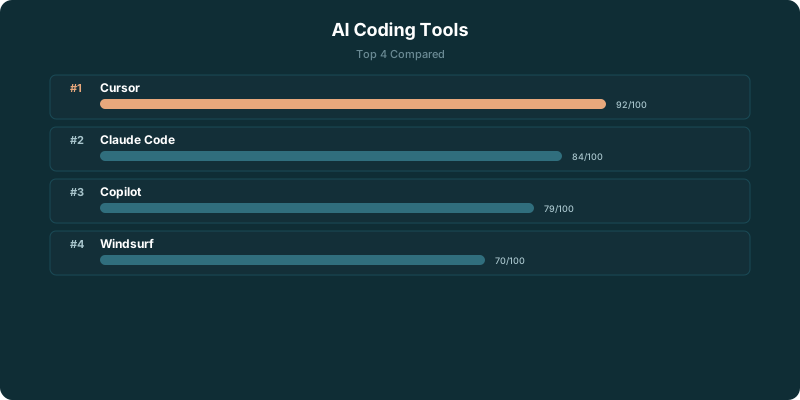
Cursor remains the best overall AI code editor. Its inline editing (Cmd+K), multi-file Composer, and project-wide context indexing are unmatched. The tab completions are fast and accurate. The diff view for AI-generated changes lets you review before accepting. For developers who want AI deeply integrated into the editing experience, nothing else comes close.
Price: $20/month (Pro), $40/user/month (Business)
Best for: Developers who want AI in every keystroke. Full-time coding roles.
Weakness: Premium request limits can run out mid-month for heavy users.
#2: Windsurf
Windsurf's Cascade feature is its killer differentiator. Describe a multi-step task, and it plans and executes across files, terminal, and browser. For refactoring, scaffolding, and feature implementation, Cascade often outperforms Cursor's Composer because it thinks in workflows rather than individual edits. The completions are slightly behind Cursor but improving with every update.
Price: $15/month (Pro), $30/user/month (Team)
Best for: Developers who prefer describing tasks over manual editing. Excellent value.
Weakness: Completions occasionally miss project-specific patterns.
#3: GitHub Copilot
Copilot is the safe choice. It works in your existing editor (VS Code, JetBrains, Neovim) without forcing a switch. The completions are reliable. The chat is functional. Copilot Workspace adds agentic capabilities for larger changes. It won't blow your mind, but it will make you consistently faster with zero disruption to your workflow.
Price: $10/month (Individual), $19/user/month (Business)
Best for: Developers committed to their current editor. Teams on GitHub Enterprise.
Weakness: Limited cross-file awareness compared to Cursor.
Category 2: AI CLI Tools
Command-line AI tools are the fastest-growing category. They fit into terminal-centric workflows where editors feel too heavy.
#1: Claude Code
Claude Code from Anthropic is the standout CLI tool of 2026. It runs in your terminal and can read, write, and refactor code across your project. Its understanding of project structure is remarkable. You can point it at a codebase, describe what you want, and it produces coherent multi-file changes. The agentic capabilities (running commands, reading output, iterating) make it more than a chat interface.
Price: Usage-based through Claude API
Best for: Terminal-native developers. Complex refactoring. Code review.
Weakness: Requires API spend management. Costs can add up on large operations.
#2: Aider
Aider is the open-source alternative to Claude Code. It connects to any model (Claude, GPT-4, local models) and provides git-integrated code editing from the terminal. Changes are committed automatically with clear commit messages. The map-of-the-repository feature gives the AI context about your entire project. For developers who want CLI AI assistance without vendor lock-in, Aider is excellent.
Price: Free (open source). You pay for API usage.
Best for: Open-source advocates. Developers who want model flexibility.
Weakness: Less polished UX than commercial alternatives.
Category 3: Code Review and Quality
AI code review tools catch bugs and suggest improvements before human reviewers spend their time.
#1: CodeRabbit
CodeRabbit integrates with GitHub and GitLab to automatically review pull requests. It comments on potential bugs, security issues, performance concerns, and style inconsistencies. The review quality has improved dramatically in 2026. It catches issues that human reviewers miss, especially in unfamiliar codebases. The signal-to-noise ratio is the best among AI review tools.
Price: Free for open source. $15/user/month for private repos.
Best for: Teams that want automated first-pass code review.
Weakness: Occasionally flags non-issues. Needs tuning per repository.
#2: Sourcery
Sourcery focuses on code quality suggestions rather than bug finding. It identifies opportunities to simplify code, remove duplication, and improve readability. The aim is gradual codebase improvement over time, with error catching as a secondary effect. Works as a VS Code extension and GitHub integration.
Price: Free for open source. $10/month for Pro.
Best for: Developers focused on code quality and readability.
Weakness: Narrower scope than CodeRabbit. Python-heavy.
Category 4: AI Testing Tools
Writing tests is where most developers procrastinate. AI testing tools lower the activation energy.
#1: CodiumAI (Qodo)
CodiumAI generates test suites for your existing code. Point it at a function, and it creates unit tests covering the happy path, edge cases, and error conditions. The generated tests are surprisingly good. They catch real bugs. The VS Code extension makes it a one-click operation. For developers who know they should write more tests but never do, this is the nudge that works.
Price: Free tier available. $19/month for Pro.
Best for: Developers who under-test. Teams wanting to increase coverage quickly.
Weakness: Generated tests sometimes miss domain-specific edge cases.
Category 5: Full-Stack AI Agents
These tools go beyond code assistance into autonomous development. Still early, but advancing fast.
#1: Replit Agent
Replit Agent can build full applications from natural language descriptions. It creates the project structure, writes the code, sets up the database, and deploys. The results aren't production-grade for complex applications, but for prototypes, internal tools, and MVPs, the speed is transformative. You can go from idea to deployed app in minutes.
Price: Included with Replit Pro ($25/month)
Best for: Rapid prototyping. Non-developers who need simple applications. MVPs.
Weakness: Code quality insufficient for complex production applications.
#2: Devin
Devin (from Cognition) represents the most ambitious vision for AI coding: an autonomous software engineer. It can take a GitHub issue, plan a solution, write code, run tests, and submit a PR. The results are mixed. Simple tasks work well. Complex tasks often require significant human intervention. The technology is impressive but not yet reliable enough to replace human engineers.
Price: Enterprise pricing (contact for quote)
Best for: Teams with large backlogs of well-specified tickets.
Weakness: Expensive. Unreliable on complex tasks. Requires careful ticket specification.
The Optimal AI Coding Stack
You don't need every tool on this list. Here's the stack I recommend by developer profile.
Editor: Cursor Pro ($20/month) or Windsurf Pro ($15/month)
CLI: Claude Code or Aider (usage-based, ~$15-35/month)
Testing: CodiumAI free tier
Total: ~$35-55/month for a dramatic productivity increase.
Editor: Cursor Business ($40/user/month) or Copilot Business ($19/user/month)
Code Review: CodeRabbit ($15/user/month)
Testing: CodiumAI Pro ($19/user/month)
Total: $50-80/user/month depending on editor choice.
Tools I Stopped Using (and Why)
Not every popular tool survived real-world testing. A few tools that get attention but didn't earn a spot:
Amazon CodeWhisperer (now Q Developer): Fine for AWS-specific code. Mediocre everywhere else. If you're not deep in the AWS ecosystem, Copilot does everything it does but better.
Tabnine: Was competitive in 2024. Has fallen behind Cursor and Copilot on completion quality. Its privacy-focused local model option is interesting but the quality gap with cloud models is too wide for most use cases.
ChatGPT for code (copy-paste workflow): Still works. Still popular. But dedicated coding tools are so much faster that the copy-paste-from-browser workflow feels primitive in comparison. If you're still using ChatGPT as your primary coding tool, try any dedicated editor integration for a week. You won't go back.
What's Coming Next
The AI coding tool market is consolidating. Within 12 months, expect the editors (Cursor, Windsurf, Copilot) to absorb most of the standalone tool capabilities. Code review, testing, and deployment will become features, not separate products.
The bigger shift is toward agentic development: AI that handles entire tasks end-to-end rather than assisting with individual edits. Claude Code and Devin represent early versions of this. By late 2026, your AI coding tool won't just help you write code. It will write the first draft, test it, and hand you a PR to review. Your job shifts from writing code to directing and reviewing AI-generated code.
That transition is already happening. The developers who lean into it now will have a significant advantage over those who wait.
Frequently Asked Questions
Do I need multiple AI coding tools or is one enough?
One editor-level tool (Cursor, Copilot, or Windsurf) covers 80% of use cases. Adding a CLI tool like Claude Code for complex refactoring and a code review tool like CodeRabbit for teams adds the remaining 20%. Most solo developers only need an AI editor. Teams benefit from the full stack.
Are AI coding tools worth paying for?
Yes, if you code for a living. A $20/month tool that saves 30 minutes per day is a 75x return on investment. Even conservative estimates show significant time savings. The free tiers are good for evaluation but too limited for daily professional use.
Will AI coding tools replace developers?
Not in 2026 or 2027. They replace tedious parts of development (boilerplate, simple tests, documentation) and augment everything else. The best developers in 2026 use AI tools aggressively and produce 2-3x more output than those who don't. AI changes what developers do, not whether they're needed.
Which AI coding tool has the best free tier?
GitHub Copilot offers a free tier with limited completions. CodiumAI's free tier is generous for test generation. Aider is fully free (open source) if you bring your own API key. For pure code editing assistance, Copilot's free tier is the most practical starting point.
What are the best AI coding tools in 2026?
The best AI coding tools in 2026 are Cursor Pro ($20/month) for keystroke-level AI editing, Windsurf Pro ($15/month) for plan-and-execute Cascade workflows, GitHub Copilot ($10 to $19/user/month) for staying inside VS Code or JetBrains, Claude Code (usage-based via the Claude API) for terminal-native development, Aider (free, open source) for terminal AI with model choice, CodeRabbit ($15/user/month) for automated code review, CodiumAI / Qodo ($19/month) for AI-generated tests, Replit Agent (included in Replit Pro at $25/month) for full-app prototyping, and Devin (enterprise) for autonomous backlog work. Most professional developers ship the most value from one editor (Cursor or Copilot) plus one terminal tool (Claude Code or Aider).
What is the best AI coding tool for a solo developer in 2026?
Cursor Pro at $20/month, or Windsurf Pro at $15/month if budget matters, plus Claude Code or Aider on the terminal. Total monthly spend is roughly $35 to $55 including API usage. This stack covers inline completions, multi-file refactors, terminal-based agentic work, and free CodiumAI test generation. A solo developer does not need CodeRabbit or Devin unless they are reviewing other people's code or operating an issue-driven backlog.
What is the best AI coding tool for a team in 2026?
For teams, the recommended stack is Cursor Business ($40/user) or GitHub Copilot Business ($19/user) for the editor, CodeRabbit ($15/user) for AI code review on pull requests, and CodiumAI Pro ($19/user) for AI-generated tests. Total is $50 to $80 per user per month depending on editor choice. Teams that already standardize on VS Code or JetBrains tend to skew toward Copilot Business for the lowest disruption. Teams that want maximum AI density choose Cursor Business. Adding Claude Code on top is common for senior engineers.
Cursor vs Copilot vs Windsurf: which is the best AI coding tool in 2026?
Cursor wins for raw AI density and multi-file editing power and is the most popular choice for full-time AI-assisted development. Windsurf wins for plan-and-execute Cascade workflows and for value at $15/month versus Cursor's $20. Copilot wins for developers who refuse to switch editors and for teams already on GitHub Enterprise that want one bill and one identity provider. The honest answer: Cursor and Windsurf both beat Copilot on raw capability in 2026, but Copilot is the safest team-wide pick because it slots into existing IDEs. See our Cursor vs Copilot vs Windsurf head-to-head for the full breakdown.
What is the best free AI coding tool in 2026?
For pure no-cost AI coding assistance in 2026, the strongest options are GitHub Copilot Free (limited completions, generous enough for hobbyists), Aider (open-source CLI, free to install but you pay for API tokens or run a local model), and CodiumAI Free (test generation up to a monthly cap). If you have a Claude or OpenAI subscription already, the highest-quality free-feeling option is Aider pointed at the model you are already paying for. The Cursor free tier exists but is too token-restricted for daily use.